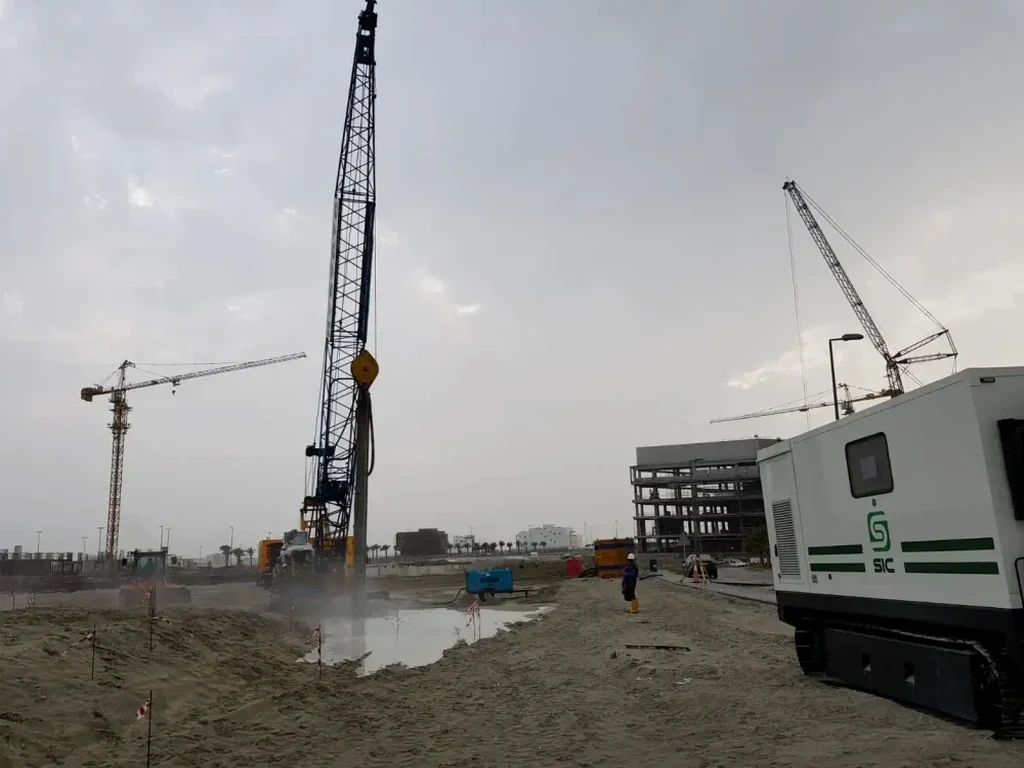
Hartford sits on the Connecticut River floodplain. That means deep deposits of loose, saturated sands right where developers want to build. IBC Section 1803.5.5 and ASCE 7-22 Chapter 20 make one thing clear: you need a defensible ground improvement plan before excavation starts. Our vibrocompaction design service tackles the problem directly. We start with a targeted geotechnical investigation—SPT drilling to measure relative density and CPT testing for continuous tip resistance profiles. Then we model the compaction grid spacing, energy input, and depth of influence. The output is a stamped, construction-ready specification that tells the contractor exactly what to do. No guesswork. No rework later. We know the glacial and alluvial soils under this city because we have logged hundreds of borings from Windsor to South Green.
Loose sand under your footing does not compact itself. It needs a precise grid, measured energy, and verification borings—anything less is a gamble.
Site-specific factors
South Meadows and the Brainard Airport area sit on loose, saturated sands that can lose over 15 percent of their volume under cyclic loading. Downtown Hartford, closer to the river, has thicker clay lenses that do not respond to vibrocompaction at all. That contrast—granular soil on one block, fine-grained on the next—is where bad designs fail. If you propose vibratory compaction in silt, you waste the contractor's time and the owner's money. Our design process rules out unsuitable zones early. We map the stratigraphy with CPT soundings and Atterberg limits, then define treatment boundaries where the soil actually responds. The result is a plan that densifies what can be densified and leaves nothing to chance. In a city where the next design earthquake could be a 2475-year event per ASCE 7, that distinction matters.
Quick answers
What does vibrocompaction design cost for a typical site in Hartford?
Design fees for a standalone vibrocompaction plan in the Hartford area typically range from US$1,290 to US$5,580, depending on site size, subsurface complexity, and the number of pre- and post-treatment verification borings required. Larger industrial sites with multiple treatment zones and deeper compaction depths fall at the upper end of that range.
How deep can vibrocompaction treat the loose sand under Hartford?
With high-power vibrators in the 250–350 kW range, we routinely design treatments to depths of 25 to 30 meters below working grade. The Connecticut River valley deposits in Hartford are well within that window. Actual achievable depth depends on probe weight, vibrator frequency, and the presence of any intermediate clay layers that can dampen energy transfer.
How do you verify that the compaction worked?
We specify a pre- and post-treatment testing program using SPT borings and CPT soundings at the same locations. The acceptance criteria are based on a target relative density or minimum N-value increase. We compare before-and-after profiles side by side in the final report so the structural engineer and building official can see exactly what changed.
Does vibrocompaction work everywhere in Hartford?
No. It works well in clean to slightly silty sands, which are common in parts of South Meadows and along the river. But downtown Hartford has discontinuous clay lenses and silt layers that do not densify under vibration. Our pre-design investigation maps those zones so we do not specify vibratory methods where they will not work. In those areas, we may recommend stone columns or other alternatives.
How long does the design process take from start to finish?
A typical vibrocompaction design package, including field investigation, laboratory grain-size testing, and engineering analysis, takes two to three weeks. Expedited schedules are possible for time-sensitive projects, especially when existing geotechnical data from nearby borings is available.