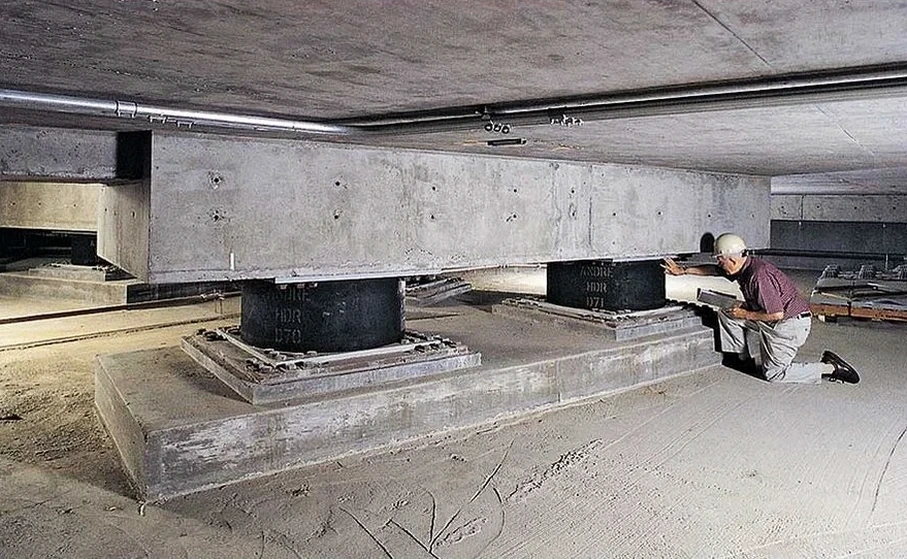
In Hartford, many of the older institutional and commercial buildings rely on foundation systems that predate modern seismic detailing, which becomes a critical consideration when you look at the underlying geology. The Connecticut River Valley cuts through the city, leaving a blanket of glacial lake deposits and varved clays over the Paleozoic metamorphic bedrock. When a structural upgrade or new essential facility is on the table, we see design teams turning to seismic microzonation studies to characterize how those soft silts modify ground motion before it ever reaches the isolator plane. Our laboratory works directly with the isolator manufacturer and the structural engineer of record, running the full prototype and production test sequence so that the bearings perform as modeled under site-specific spectra. For critical care units and emergency operations centers in the Capitol region, combining isolation with an in-situ permeability assessment of the bearing stratum helps confirm that long-term groundwater exposure will not degrade the elastomer or the sliding surfaces over the design life of the structure.
An isolation system that performs on paper but loses damping after the first cycle does not protect the building; it just adds cost to the foundation.
Our approach and scope
The hardware that makes base isolation work in Hartford is almost always either a high-damping rubber bearing or a friction pendulum slider, and the test protocol runs on a high-capacity dynamic testing machine with a vertical actuator that can hold up to 10,000 kN while the horizontal actuator cycles the bearing through the full design displacement. We instrument the specimen with displacement transducers, load cells, and thermocouples, recording the hysteresis loops in real time as the isolator undergoes three fully reversed cycles at increasing amplitudes per ASCE 7 Chapter 17. The most revealing part of the sequence is the scragging and aging protocol, where we track the drop in effective shear modulus between the first and third cycle, a change that directly affects the period shift the isolation system provides. Because Hartford lies in a moderate seismicity region where the design earthquake is often a distant M6 to M6.5 event, the effective damping and the post-elastic stiffness must be confirmed at both the service-level and maximum considered earthquake displacements, which means the same bearing set gets tested under multiple hazard levels before it ever leaves the lab.
Site-specific factors
The 2020 earthquake near East Freehold, New Jersey, though only a magnitude 3.1, was felt in parts of Connecticut and served as a reminder that the Hartford Basin sits within a seismotectonic framework where moderate events occur on ancient fault structures reactivated by far-field stresses. When a base-isolated hospital or data center experiences even a moderate event, the consequence of getting the isolator properties wrong is not drift in the superstructure; it is the possibility that the isolation plane locks up or displaces beyond the moat clearance, transferring the full spectral acceleration into the supported equipment. The varved clays along the Connecticut River introduce a basin-edge effect that can amplify long-period energy, exactly the frequency range where an isolated structure is tuned, so verifying isolator properties at prototype scale becomes the single most consequential quality-control step in the entire project delivery chain.
Reference standards
ASCE/SEI 7-22 Minimum Design Loads and Associated Criteria for Buildings and Other Structures, Chapter 17: Seismic Design Requirements for Seismically Isolated Structures, IBC 2021 Section 1705.13.4: Testing of seismic isolation systems, ASTM D4014 Standard Specification for Plain and Steel-Laminated Elastomeric Bearings for Bridges, referenced for material acceptance criteria, AASHTO Guide Specifications for Seismic Isolation Design, applied where the structure interfaces with state highway infrastructure
Quick answers
What does base isolation testing cost for a building in Hartford?
For a project with eight to twenty isolators, prototype and production testing typically runs between US$3,910 and US$8,820, depending on whether the scope includes full thermal conditioning and aging protocols or just the mandatory ASCE 7 production lot verification.
Which ASCE 7 provisions govern isolation testing in Connecticut?
Chapter 17 of ASCE 7-22 governs the analysis, design, and testing of seismically isolated structures. The testing requirements specify that every isolator type and size must undergo prototype testing with at least two full-scale specimens, followed by production testing on a per-lot basis, with the acceptance criteria tied to the bounding values established during the prototype sequence.
Do Hartford buildings need base isolation for moderate seismicity?
For essential facilities like hospitals, emergency response centers, and data centers, IBC Table 1604.5 assigns Risk Category IV, which triggers stricter performance objectives. In these cases, base isolation becomes a rational strategy not because Hartford sees frequent large earthquakes, but because the consequence of even a moderate event on a critical facility justifies the additional protection and the operational continuity that an isolated structure provides.
How do the glacial lake deposits under Hartford affect isolator performance?
The varved clays and silts of Glacial Lake Hitchcock, which underlie much of downtown Hartford, have a shear wave velocity profile that tends to amplify ground motion in the 1.0 to 2.5 second period range. Since base-isolated buildings are typically tuned to periods around 2.0 to 3.0 seconds, the site amplification can increase the displacement demand on the isolators, which is why the prototype test must be run at the site-specific displacement rather than a generic code value.
What is the difference between prototype testing and production testing for isolators?
Prototype testing is carried out on two or more full-scale bearings before production begins and covers the complete range of loading, including maximum displacement, aging, scragging, and temperature effects. Production testing is the quality-control verification performed on samples from each manufacturing lot, checking that the key properties—effective stiffness and damping at the design displacement—fall within the acceptance window established during the prototype phase, typically ±15 percent of the prototype mean values.