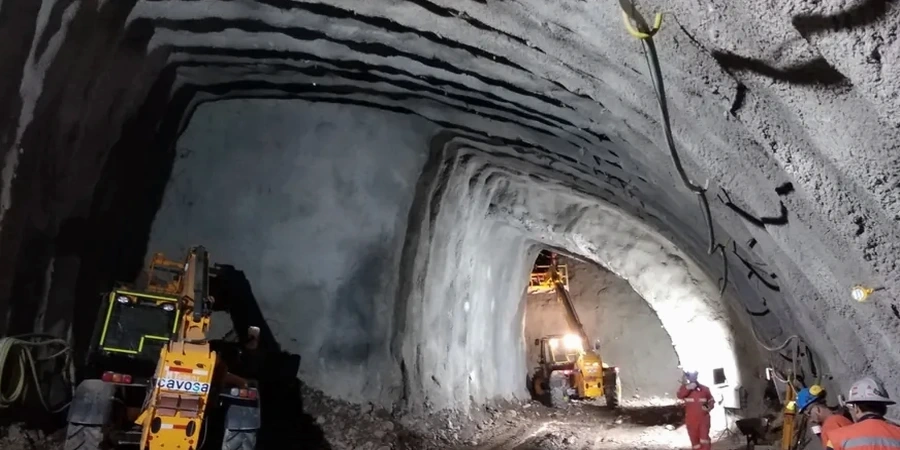
The most expensive mistake a contractor makes in Hartford is assuming the soil will behave like Boston blue clay. It won't. The Connecticut River Valley varved silts and post-glacial lake deposits under downtown Hartford fail differently—progressive softening, rapid pore pressure response, and tunnel face instability that standard PLAXIS defaults miss. We see it in bids that blow out by 40% because the baseline geotechnical report underestimated stand-up time. Before you commit to a TBM type or open-face mining sequence, the investigation needs to capture the true undrained shear strength profile and the horizontal stress anisotropy locked into those glacially overconsolidated deposits. A well-placed CPT test program with pore pressure dissipation readings gives you that continuous stratigraphic resolution, and when combined with targeted SPT drilling for disturbed sampling, the ground model becomes defensible enough to support a design-build proposal without burying contingencies.
Tunnel face stability in Hartford's varved silts isn't about peak friction angle—it's about the undrained strength anisotropy that standard lab programs overlook.
Reference standards
ASCE 7-16 Chapter 21: Site-Specific Ground Motion Procedures, IBC 2021 Section 1613: Earthquake Loads, ASTM D1586: Standard Penetration Test (SPT), ASTM D4767: Consolidated-Undrained Triaxial Compression Test, ASTM D6913: Particle-Size Distribution (Sieve Analysis), FHWA-NHI-10-034: Technical Manual for Design and Construction of Road Tunnels
Quick answers
What's the typical cost for a soft-ground tunnel geotechnical investigation in Hartford?
For a downtown Hartford alignment of roughly 500 to 1,500 linear feet, the field and laboratory investigation typically ranges from US$4,000 to US$14,310 depending on the depth to till, the number of CPT soundings and borings required, and the complexity of the triaxial testing program. A phased approach that starts with CPTu profiling and then targets Shelby tube sampling often gives the best value.
How do you account for the varved silt fabric in the tunnel design parameters?
The varved fabric creates strong stiffness anisotropy that conventional isotropic models miss. We run CIU triaxial tests on specimens trimmed at multiple orientations relative to the bedding, then use the results to define the undrained strength ratio for the tunnel crown versus the springline. The data feeds directly into finite element models so the contractor sees different stand-up times for the heading versus the sidewalls.
What triggers the need for a site-specific seismic response analysis under ASCE 7?
When the IBC classifies the site as Class E or F—common in Hartford due to the soft Lake Hitchcock silts exceeding 10 feet in thickness—ASCE 7-16 Chapter 21 requires a site-specific ground motion hazard analysis. The analysis must capture the nonlinear modulus reduction and damping curves specific to the varved silt, which we derive from resonant column tests or calibrated MASW profiles.
How quickly can you mobilize a CPT rig in downtown Hartford?
We can typically have a 20-ton CPT truck on site within 5 to 7 business days of authorization, assuming the traffic control permit for the lane closure is already in hand. For tight alley access near Pratt Street or the XL Center, we also have a smaller tracked CPT platform that fits through a standard double door.