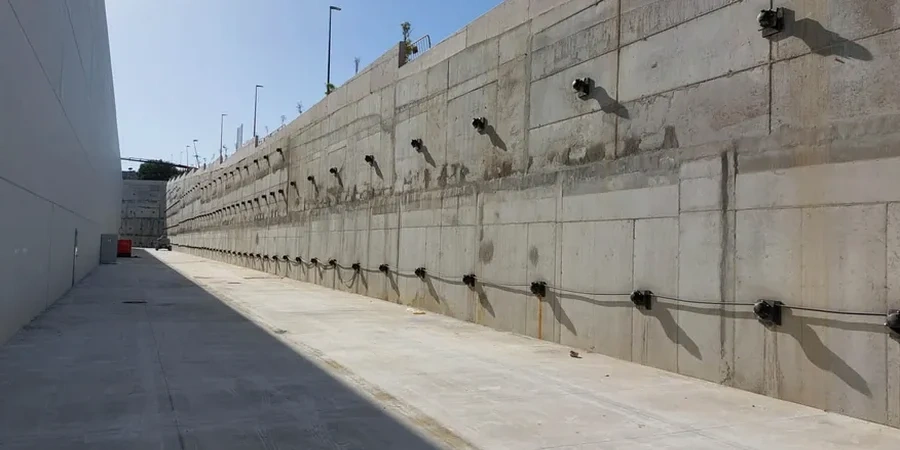
Hartford’s geology splits sharply at the Connecticut River. East of the river, in areas like East Hartford, glacial lake deposits dominate—layers of varved silt and clay that behave poorly under lateral load. West of downtown, toward the Capitol area, you hit dense glacial till and the reddish-brown Portland Arkose formation. Anchor design must adapt to this contrast. A passive tendon grouted into stiff till performs differently than one in soft varved clay near the Bulkeley Bridge. Our team works both sides of the river, designing active tieback systems for deep excavations and passive anchors for permanent slope retention, always tied to site-specific test pit data and tensile load testing.
Hartford’s varved clay anchors can lose 15% of lock-off load in the first 30 days if not proof-tested correctly.
Site-specific factors
We’ve seen too many Hartford projects where the anchor design assumed uniform soil conditions across the site, only to hit a pocket of organic silt where the varved clay pinches out. That’s a bond zone failure waiting to happen. The biggest risk in this city is underestimating the creep sensitivity of the glacial lake deposits—they don’t fail suddenly, but they relax over weeks, and suddenly your excavation wall is deflecting 2 inches inward. We never finalize a bond length without confirmation borings at each anchor row elevation. In the South Meadows area near the river, high groundwater complicates grout curing, so we specify early-strength grout mixes and extend the proof-testing window when needed. A failed anchor behind a soldier pile wall on a tight urban site isn’t just a geotechnical problem—it becomes a public safety issue.
Quick answers
What’s the typical cost range for anchor design on a Hartford project?
Anchor design engineering fees generally run from US$1.130 to US$3.970 depending on the number of anchor rows, whether active or passive systems are required, and the complexity of corrosion protection detailing. A single-tier temporary tieback design for a shallow excavation falls on the lower end; a multi-level permanent anchor system with double corrosion protection and extended proof testing will be at the upper end.
How do you determine whether active or passive anchors are right for a site?
It depends on allowable wall deflection and site geometry. Active anchors apply prestress immediately and limit movement—essential when excavating next to existing structures in downtown Hartford. Passive anchors engage only when the wall starts to move, which works for cut slopes or remote abutments but not for tight urban excavations.
How long does anchor design and testing take?
Design and submittal typically take 2 to 3 weeks after we receive the geotechnical report and wall layout. Field load testing—proof and performance tests—adds another 1 to 2 weeks depending on the number of anchors tested and whether extended creep tests are specified for varved clay zones.
What soil conditions in Hartford affect bond length the most?
The varved silt and clay east of the Connecticut River and in low-lying areas near downtown. These glaciolacustrine deposits exhibit time-dependent creep under sustained load, which forces longer bond lengths and conservative lock-off procedures. In contrast, the glacial till west of the river usually allows shorter, more efficient bond zones.