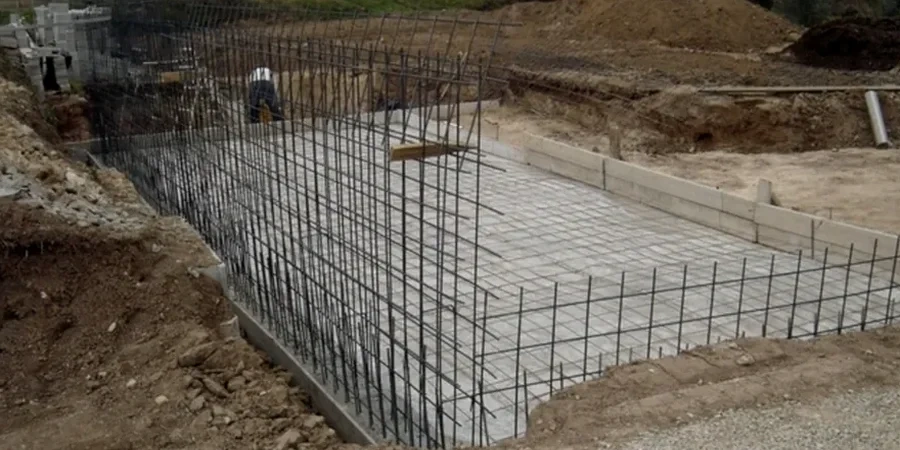
A five-story mixed-use project off Albany Avenue hit refusal at three feet—cobbles and boulders locked in hardpan that a standard excavator couldn’t break. That’s Hartford geology in a nutshell. Between the Connecticut River floodplain and the eastern uplands, the city sits on a complex package of glacial till, varved lake deposits, and occasional man-made fill that has been reworked since the 17th century. In our experience, shallow foundation design here rarely follows textbook assumptions. Bearing capacity can swing from 2,000 psf in soft alluvium near the river to over 8,000 psf on dense till just a half-mile east. We integrate subsurface data from test pits and SPT borings to map those transitions before sizing a footing, so the design reflects what’s actually under the site—not a regional default. For tight urban lots where settlement control drives the decision, we also pull CPT profiles to catch thin compressible lenses that a split-spoon sampler might miss.
Good shallow foundation design in Hartford isn’t about using higher bearing pressures—it’s about knowing where the till pinches out and the varved clay begins.
Our approach and scope
Hartford’s downtown grid grew on land that was largely low-lying and poorly drained, which meant early builders raised street grades with fill that still lurks beneath many foundations today. That legacy makes shallow foundation design in the city equal parts geotechnical investigation and historical detective work. We routinely encounter buried organics, old timber piles from 19th-century structures, and variable thicknesses of undocumented fill in the Downtown and Sheldon-Charter Oak neighborhoods. Our team relies on ASTM D2487 for unified soil classification and ASTM D1586 for standard penetration testing, then applies ASCE 7 load combinations and IBC Chapter 18 bearing capacity provisions to size footings appropriately. When working along the Park River conduit or near the Whitehead Highway, groundwater management becomes a controlling factor—seasonal fluctuations of three to four feet are common, and ignoring them during a dry August investigation can produce overly optimistic designs that underperform in March.
Site-specific factors
The mistake we see repeatedly: designers pull a presumptive bearing value of 3,000 psf from the IBC table and apply it across an entire Hartford site without verifying subsurface continuity. In the northern part of the city, where glacial Lake Hitchcock deposited rhythmically layered silts and clays, that shortcut can produce differential settlements that crack masonry within the first three freeze-thaw cycles. Varved soils are notoriously anisotropic—they drain well horizontally but consolidate slowly under vertical load. If a shallow foundation design does not account for that behavior, tilt and distress show up fast. Another common failure mode involves placing footings on compacted fill that was never tested for density or moisture content, especially on former industrial parcels near the North Meadows. Without a density verification protocol tied to ASTM D1557, the fill’s performance under sustained load is anyone’s guess—and courts in Connecticut have not been kind to teams that guessed wrong.
Quick answers
What is the minimum footing depth required in Hartford?
The Connecticut building code, which adopts the IBC, requires a minimum footing embedment of 42 inches below finished grade for frost protection. However, depth is also governed by bearing stratum—if competent till is encountered at 30 inches, we still extend to 42 inches to prevent frost heave. In heated structures with insulated foundations, the code permits reductions, but Hartford’s historically cold winters mean we rarely recommend going shallower than 36 inches even with insulation.
How much does a shallow foundation design cost for a Hartford project?
For a typical single-family residential or small commercial building in the Hartford area, shallow foundation design services generally range from US$1,670 to US$3,100. The final figure depends on whether the project requires a full geotechnical investigation with borings, the complexity of the soil profile, and the number of foundation elements to be designed. Larger projects or those on problematic fill parcels will fall toward the upper end or beyond.
Can you design footings on sites with known fill near the Connecticut River?
Yes, and we do it regularly. The key is characterizing the fill’s thickness, composition, and density before design. In the riverfront and North Meadows areas, fill can extend 8 to 15 feet deep. We typically advance borings through the fill into natural material, run laboratory compaction and consolidation tests on samples, and then decide whether the fill can support footings after improvement or if deep foundations become more economical.
How does Hartford’s seismic classification affect footing design?
Hartford sits in a region where ASCE 7 maps assign Site Class C or D depending on the upper 100 feet of the soil profile. Site Class D, common where softer varved clays and loose fills are present, amplifies short-period ground motions and increases the seismic design category. That means footings must be positively connected to the structure above, with reinforcement detailed for the amplified demands, and bearing capacity checks must include seismic load combinations that reduce the allowable pressure by one-third per IBC Section 1605.
What’s the difference between a mat foundation and isolated footings for Hartford soils?
Isolated footings work well when bearing strata are consistent and settlements are small. We specify mat foundations—essentially a single thick slab under the entire footprint—when the soil is highly variable, total settlements exceed one inch, or differential settlement between columns is projected to be more than half an inch. In Hartford’s varved clay zones, a mat bridges softer pockets and reduces the risk of angular distortion that would crack the superstructure. The trade-off is more concrete and reinforcement, but the long-term performance on marginal ground often justifies the cost.