← Home · Laboratory

Advanced Triaxial Testing Services for Hartford Connecticut Projects

Together, we solve the challenges of tomorrow.

LEARN MORE →

Skipping a proper triaxial test on Hartford’s layered glacial deposits is one of the most expensive shortcuts a contractor can take. We’ve seen deep excavations in the Connecticut River Valley fail because the designer assumed uniform clay behavior, only to encounter silty lenses that lost strength rapidly under load. The triaxial test measures shear strength parameters—cohesion and friction angle—under controlled drainage conditions, something a simple unconfined compression test cannot do. For projects near the Park River conduit or the thick varved clays beneath downtown, this data feeds directly into bearing capacity calculations and slope stability models. Without it, even a conservative factor of safety can be misleading, and the cost to remediate a failed excavation on a tight urban lot in Hartford’s Asylum Hill neighborhood runs far higher than the price of a complete laboratory program.

A CU triaxial test on Hartford varved clay typically reveals an effective friction angle 4 to 7 degrees higher than the total-stress envelope, a difference that directly impacts excavation support design.

Our approach and scope

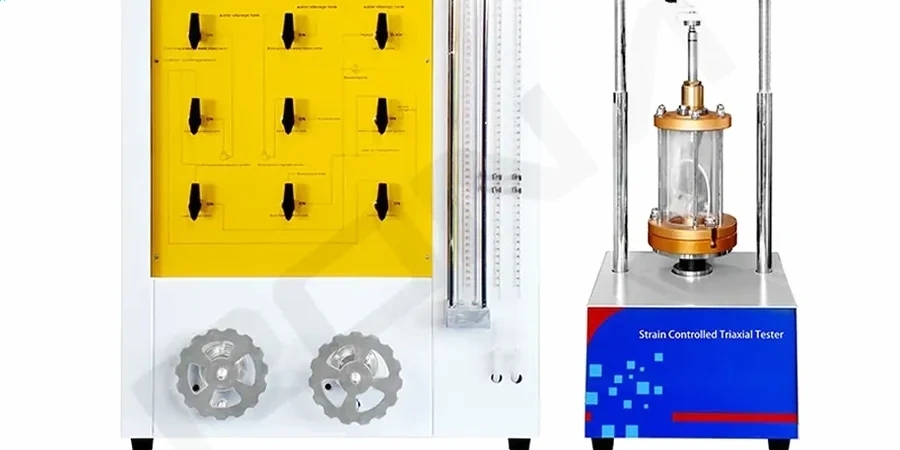
The heart of the system is a triaxial cell machined from stainless steel, capable of confining pressures up to 10,000 psi for testing Hartford’s dense glacial till. Our setup uses three 70-mm-diameter specimens trimmed from undisturbed Shelby tube samples, with porous stones and filter-paper side drains to accelerate saturation. Electronic pressure-volume controllers apply back-pressure in precise increments, achieving Skempton’s B-value above 0.95 before the shear stage begins. For projects requiring stiffness data, we mount submersible LVDTs directly on the specimen to eliminate seating errors. This equipment configuration allows us to run consolidated-undrained (CU) and consolidated-drained (CD) protocols on the same formation, which is essential when comparing strength envelopes for footings on the silty sands of the Terrace deposits versus the lean clays of the Lake Hitchcock sediments. The entire process is monitored through a data acquisition system recording axial load, pore pressure, and volume change at one-second intervals.
Advanced Triaxial Testing Services for Hartford Connecticut Projects
Technical reference image — Hartford Connecticut

Site-specific factors

The contrast between downtown Hartford’s fill-over-lacustrine sequence and the glacial outwash in West Hartford creates two entirely different triaxial testing requirements. Downtown, the soft varved clays demand CU tests with pore pressure measurement to capture the effective stress behavior—skip this step and your deep excavations bracing design will underestimate lateral earth pressures by 15 to 20 percent. In the western suburbs, the granular outwash calls for CD triaxial testing to define the drained friction angle that governs bearing capacity for spread footings. A project that collects samples from both zones and runs only unconsolidated-undrained tests is gambling with the design envelope. The IBC and ASCE 7 load combinations assume site-specific shear strength; when the triaxial data is missing or misapplied, the geotechnical report’s recommendations become little more than regional defaults that do not reflect Hartford’s complex glacial stratigraphy.

Need a geotechnical assessment?

Reply within 24h.

Email: [email protected]

Technical parameters

ParameterTypical value
Applicable ASTM StandardsD4767 (CU), D2850 (UU), D7181 (CD)
Specimen Diameter70 mm (2.8 in) for standard soils
Maximum Confining Pressure10,000 psi (69 MPa)
Back-Pressure SaturationSkempton B-value ≥ 0.95
Shear Rate (CU test)0.001–0.01 in/min per ASTM D4767
Data Acquisition Rate1 Hz (adjustable)
Report Turnaround5–7 business days after sample receipt
Sample PreservationMoisture-controlled storage at 4°C per ASTM D4220

Other technical services

01

Consolidated-Undrained (CU) Triaxial with Pore Pressure

Three-stage CU test per ASTM D4767 on undisturbed Hartford clay samples. Measures effective cohesion (c') and effective friction angle (φ') with pore pressure transducers at the base. Ideal for excavation support design and slope stability analysis in the Connecticut River Valley varved clays.

02

Consolidated-Drained (CD) Triaxial for Granular Soils

Slow-shear CD test per ASTM D7181 on remolded or undisturbed granular specimens. Determines the drained strength envelope for bearing capacity calculations under footings in Hartford’s glacial outwash and terrace deposits, including volume-change measurement throughout shear.

Reference standards

ASTM D4767-11: Standard Test Method for Consolidated Undrained Triaxial Compression Test for Cohesive Soils, ASTM D2850-15: Standard Test Method for Unconsolidated-Undrained Triaxial Compression Test on Cohesive Soils, ASTM D7181-20: Standard Test Method for Consolidated Drained Triaxial Compression Test for Soils, ASTM D4220-95(2014): Standard Practices for Preserving and Transporting Soil Samples

Quick answers

What is the typical cost range for a triaxial test program in Hartford?

A full three-stage CU or CD triaxial test program on undisturbed Hartford samples generally runs between US$1,910 and US$3,050, depending on the number of confining pressures specified, the need for pore pressure measurement, and whether the specimens require special trimming due to gravel content in glacial till. This range covers specimen preparation through the final Mohr-Coulomb interpretation report.

Which triaxial test type should I specify for Hartford’s varved clay?

For the varved lacustrine clays common beneath downtown Hartford and along the Connecticut River, we recommend the consolidated-undrained (CU) test with pore pressure measurement per ASTM D4767. The varved structure creates anisotropic permeability; CU testing captures the effective stress behavior that controls excavation stability, while unconsolidated-undrained tests on these soils often underestimate the true drained strength.

How long does a triaxial test take from sample delivery to report?

Our standard turnaround is five to seven business days after the undisturbed Shelby tube samples arrive at the lab. The consolidation phase alone can take 24 to 48 hours for Hartford’s plastic clays, depending on sample thickness and permeability. If the project schedule is tight, we can coordinate with the drilling crew to prioritize specimen preparation and begin saturation the same day.

Can you run triaxial tests on samples with gravel from Hartford’s glacial till?

Yes, but the specimen preparation requires careful trimming and sometimes a larger-diameter specimen up to 100 mm to accommodate particles up to 1/6 of the diameter per ASTM D4767. For till with significant cobble content, we discuss with the project geologist whether in-situ shear testing such as CPT might complement the laboratory program for a more complete strength profile.
Location and service area

We serve projects in Hartford Connecticut and surrounding areas.

View larger map