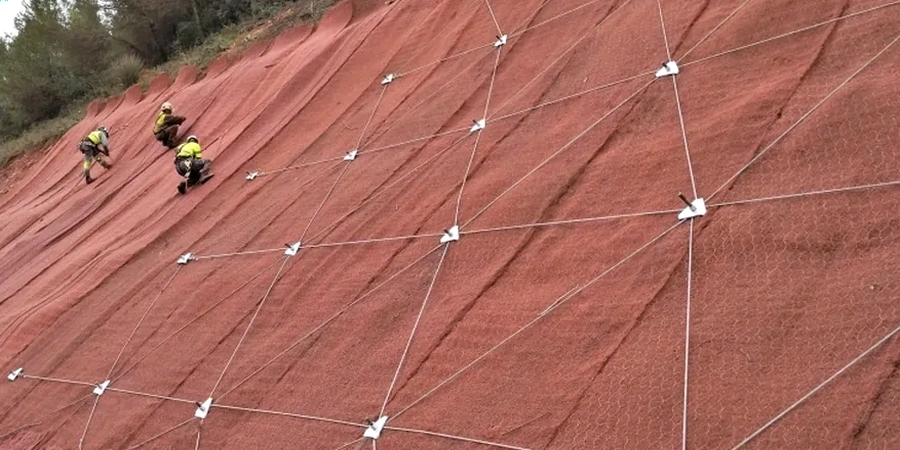
Hartford’s development along the Connecticut River carved out a city on layered glacial soils and varved clays. The downtown expansion in the 20th century pushed construction onto slopes that demand careful evaluation. Our lab team runs slope stability analysis on these formations daily. We don’t guess. We measure. A CPT test gives us continuous stratigraphy without disturbing the sample, and when we need to check fill compaction at the bench, we use a sand cone density kit right on site. Hartford’s weather cycles—freeze-thaw in winter, heavy nor’easter rains—accelerate erosion on unprotected slopes. Every analysis we deliver accounts for these local conditions.
A slope doesn't fail overnight. It fails when pore pressure exceeds shear strength. We measure both.
Site-specific factors
The most common mistake we see in Hartford is cutting a slope and leaving it unsupported through winter. Contractors finish the excavation in November, plan to install retaining structures in spring, and then the freeze-thaw cycles do the damage. Water gets into fissures, freezes, expands, and the face starts spalling. By March, the factor of safety has dropped below 1.0. Another issue is ignoring the varved clay layers. These are thin, alternating silt and clay strata deposited in glacial Lake Hitchcock. They look uniform in a test pit, but they drain at different rates. Pore pressure builds in the silt laminae and reduces effective stress fast. Our slope stability analysis pinpoints these weak layers before the excavation even starts. We map the stratigraphy, install piezometers, and monitor the water table through the critical seasons.
Quick answers
When is a slope stability analysis required in Hartford?
Hartford building officials require it under IBC Chapter 18 when you're cutting a slope steeper than 2:1, placing fill on slopes exceeding 15%, or building within 50 feet of a slope crest. It is also mandatory for permanent retaining structures over 4 feet high. The analysis must include both static and seismic conditions per ASCE 7.
What does a slope stability analysis cost in the Hartford area?
The cost ranges from US$1,290 for a basic analysis of a small cut slope with existing geotechnical data, up to US$4,400 for a full investigation including drilling, lab shear tests, piezometer installation, and a detailed report with multiple cross-sections. Every quote is project-specific.
How long does the analysis take?
Fieldwork typically takes 2-3 days. Lab testing runs 5-7 business days for direct shear and classification. The modeling and report drafting take another 5 days. A complete slope stability package—from mobilization to final report—is usually 3 weeks.
What soil parameters do you test for slope stability?
We determine effective cohesion and effective friction angle via direct shear or triaxial testing on undisturbed samples. We also run Atterberg limits, grain size distribution, and moisture content. For the varved clays common in Hartford, we pay special attention to drained versus undrained strength.